
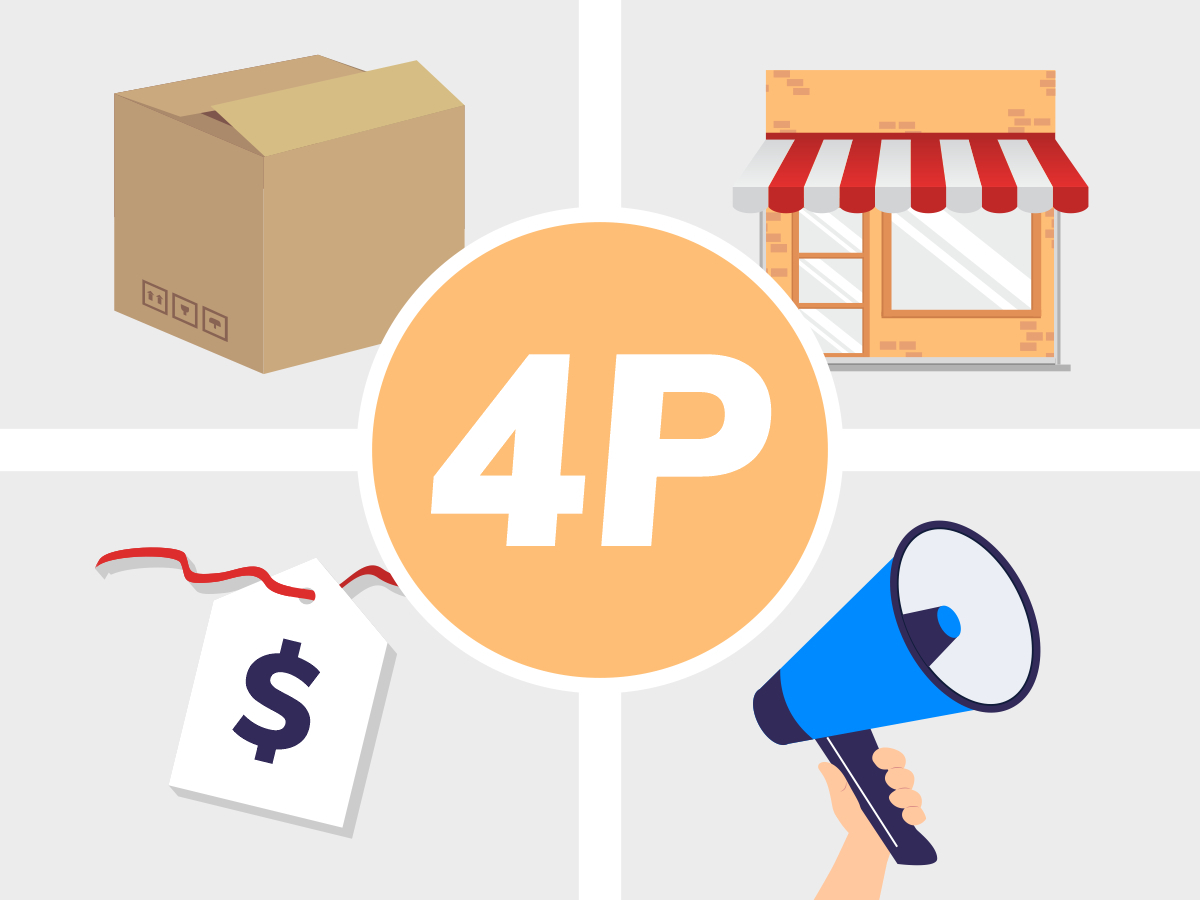
If you’ve ever taken a marketing class, you’ve likely heard of the Four Ps of Marketing: Product, Price, Place, and Promotion. First introduced by E. Jerome McCarthy in the 1960s, this framework still shapes how businesses, from startups to Fortune 500s, think about delivering value to their customers.
You may wonder if in the context of today’s digital-first world with shifting consumer expectations and tighter marketing budgets: do the Four Ps still hold up? The short answer: yes. But as with any advertising or marketing strategy, it works best if you understand how to apply them in modern contexts.
Keep reading for a breakdown of each “P,” practical insights, fresh statistics, and more resources to take your strategy further.
Table of contents
- Why the Four Ps Still Matter
- 1. Product: Creating Something Worth Talking About
- 2. Price: Balancing Value and Perception
- 3. Place: Meeting Customers Where They Are
- 4. Promotion: Telling Your Story Effectively
- Beyond the Four Ps: Extensions and Critiques
- Bringing It All Together
- Key Takeaways: The 4 P’s Explained
Why the Four Ps Still Matter
Some critics argue the 4 Ps are outdated in the age of e-commerce, influencer marketing, and AI. But the truth is that they remain flexible principles as opposed to rigid rules.
- Product is still about delivering value.
- Price still signals positioning.
- Place has evolved from shelf space to digital distribution.
- Promotion has expanded to include social, content, and inbound strategies.
A recent survey by HubSpot found that 82% of marketers actively use a marketing model like the 4 Ps to structure campaigns because it forces clarity in decision-making. Any marketing professional can tell you that marketing is far from throwing a dart at a board and hoping you hit the bullseye. A smart marketing plan is carefully designed with audience and goals front of mind.

1. Product: Creating Something Worth Talking About
Your product is the foundation of your marketing mix. It’s not only the item you sell; it’s the total package of value, features, brand identity, and customer experience.
What to Consider
- Core features: What does it do?
- Design & packaging: How does it look and feel?
- Brand alignment: Does it match your company’s promise?
- Support services: Are warranties, upgrades, or customer service part of the product?
Real-World Example
Apple isn’t selling just a smartphone. It’s selling seamless integration into an ecosystem of apps, services, and devices. There’s a reason why so many people choose Apple for their devices from phones and tablets to laptops and TVs.
Common Mistakes
- Building a product you want to sell instead of one your customers need.
- Neglecting post-purchase experience, which leads to poor retention.
2. Price: Balancing Value and Perception
Price does more than cover costs; it signals quality, positions you in the market, and drives profitability.
Pricing Strategies
- Cost-plus pricing: Add a margin to production cost.
- Value-based pricing: Set price according to perceived value.
- Dynamic pricing: Adjust in real time (think airlines or rideshare apps).
- Freemium models: Offer a free entry point, charge for premium.
Key Statistics
According to a PwC survey, 86% of consumers are willing to pay more for a better customer experience. This underscores how pricing power is linked to perceived value, not just cost. On the other hand, it might not matter how affordable a product is, if customer service is nightmarish, people will likely abandon the brand altogether.
Common Mistakes
- Undervaluing your product to chase volume.
- Failing to adjust prices during inflation or market shifts.
3. Place: Meeting Customers Where They Are
“Place” used to mean shelf space in a store. Today, it spans e-commerce platforms, DTC websites, social shopping, and even the metaverse.
Distribution Choices
- Direct (your own site, pop-ups, flagship stores).
- Indirect (Amazon, retailers, wholesalers).
- Hybrid (direct-to-consumer and retail partners).
Stat to Know
eMarketer reports that online sales accounted for 19.5% of total retail sales globally in 2024, and this number continues to grow year-over-year. The online marketplace has just about taken the place of bustling shopping malls. People are willing to spend extra for the convenience of never leaving their home.
Modern Example
Nike now prioritizes its own website and apps for distribution, limiting wholesale partners. This shift boosts margins and strengthens direct customer relationships.
Common Mistakes
- Spreading too thin across channels without mastering any.
- Failing to match distribution with customer expectations (e.g., Gen Z expects mobile-first buying).
Check out our blog post about push and pull marketing for more tactics on how to both reach out to and draw in your target audience.
4. Promotion: Telling Your Story Effectively
Promotion covers all the ways you inform, persuade, and remind customers about your offering. Traditionally, this meant advertising, sales promotions, and PR. Today, it includes SEO, influencer partnerships, and real-time engagement.
Key Promotional Channels
- Digital advertising (search, display, video).
- Content marketing (blogs, whitepapers, case studies).
- Social media (organic and paid).
- Events & sponsorships.
- PR & earned media.
Stat to Know
According to Statista, global digital advertising spending reached $679 billion in 2023 and is projected to surpass $870 billion by 2027. This may not come as a surprise given the sheer volume of online ads we encounter on a daily basis.
Common Mistakes
- Broadcasting instead of engaging.
- Measuring vanity metrics (likes, impressions) instead of conversions or ROI.

Beyond the Four Ps: Extensions and Critiques
Some marketers argue the original Four Ps don’t capture today’s service-oriented economy. Popular extensions include:
- 7 Ps: Adds People, Process, Physical Evidence.
- 4 Cs: Customer, Cost, Convenience, Communication.
These frameworks build on the original, but the Four Ps remain the simplest and most universally understood starting point.
Bringing It All Together
Think of the Four Ps as levers. Adjusting one changes the others:
- A luxury product requires higher pricing, selective distribution, and refined promotion.
- A low-cost good may need mass distribution and broad promotion.
The magic lies in alignment. When Product, Price, Place, and Promotion reinforce each other, you create a marketing mix that delivers value, builds loyalty, and drives results.
Key Takeaways: The 4 P’s Explained
- Product: Build what solves problems, not just what you want to sell.
- Price: Align with value, not just cost.
- Place: Be where your customers are—digitally and physically.
- Promotion: Connect through storytelling, not just ads.
Despite being over 60 years old, the Four Ps framework continues to provide clarity in a cluttered marketing world. Mastering them isn’t just theory, it’s a practical path to measurable results. Take a deeper dive into all things marketing in the Outdoor Voice blog.
FAQs
How does “Place” impact a billboard’s success?
In the Four Ps of Marketing, “Place” refers to where your product is sold and where your ads are seen. For OOH, this means strategic placement. A billboard for a new coffee blend is most effective when “placed” on a commuter route leading to a grocery store. Proper placement ensures that the promotion happens in a location that reduces the friction between seeing the ad and making a purchase.
How do the Four Ps work together in a billboard campaign?
Each element must be aligned for the campaign to thrive. Your Product (what you’re selling) must be clearly visualized, the Price (or value proposition) must be easy to digest, the Place (the billboard location) must reach your target demographic, and the Promotion (the creative design) must be eye-catching. If one “P” is out of sync—like a luxury product placed in a rural area—the ROI of the campaign will suffer.
Why should I use the Four Ps to design my outdoor ad?
Using the Four Ps of Marketing as a checklist ensures your ad is functional, not just pretty. It helps you prioritize the most important information: what the product is, why the price/value is worth it, where it can be found, and how the promotion will grab attention. Following this framework prevents “cluttered” designs and helps create a clear, psychological path to conversion for the viewer.