
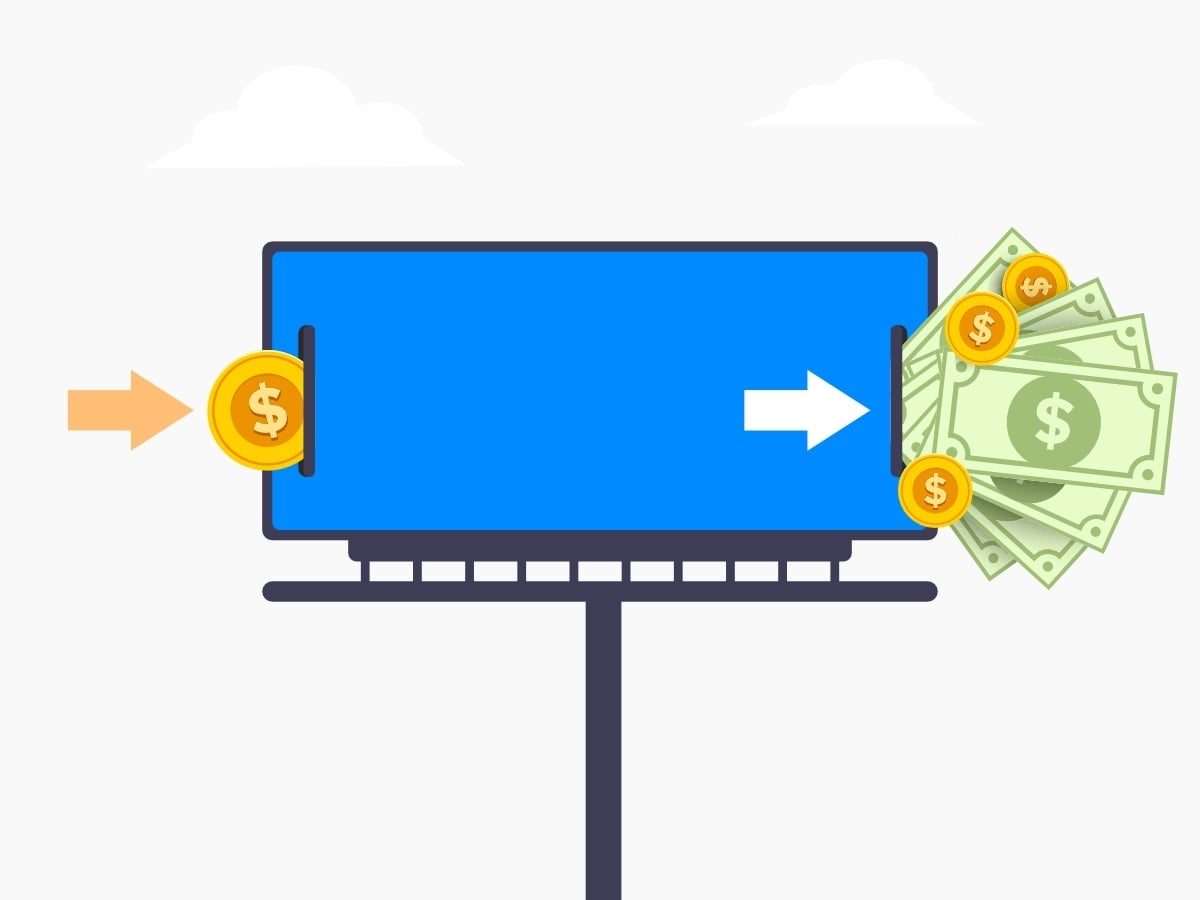
With competition and segmentation at an all-time high, marketing budgets are under more pressure than ever. Whether you’re running paid search, social media ads, or OOH campaigns, it’s essential to understand how efficiently your advertising investments generate revenue for your business.
Return on ad spend (ROAS) is one of the core metrics marketers use to measure the efficiency and effectiveness of advertising initiatives. It allows advertisers to identify successful (and unsuccessful) campaigns and compare results across marketing channels.
Keep reading to learn what ROAS is, how to calculate it, how to improve it, and more.
Table of contents
What Is ROAS in Marketing?
Return on ad spend (ROAS) measures the amount of revenue generated for every dollar invested in advertising. It’s one of the most useful key performance indicators (KPIs) for any type of paid ads, since it tells you whether your campaign is making money or losing money. ROAS can also help you identify growth opportunities, maximize your marketing budget, and make data-driven decisions.
The ROAS Formula: How to Calculate and Express ROAS
If you want to learn how to calculate ROAS, the formula is actually very simple:
ROAS = revenue from advertising/cost of advertising
For example, if your ads generated $4,000 in revenue and your advertising costs were $1,000, you would have a ROAS of 4. This means that you are generating $4 of revenue for every $1 you invest into advertising.
How to Express ROAS (As a Ratio, Percentage, or Multiplier)
ROAS can be expressed in three primary ways: as a ratio, percentage, or multiplier. Here’s a demonstration of each method (using the ROAS of 4 from the example above).
- Ratio → A ROAS of 4 could be expressed as a ratio of 4:1.
- Percentage → You can also multiply your figure by 100 if you prefer to write it as a percentage (e.g., 4 x 100 = a ROAS of 400%).
- Multiplier → Another common way to express it is as a multiplier (e.g., a ROAS of 4 = 4x).
Whether you decide to track ROAS as 4:1, 400%, or 4x, all three methods communicate the exact same information.
How to Accurately Track the Cost of Advertising
The hardest part of calculating ROAS isn’t the math—it’s making sure you are using the right numbers in your formula. In order to get an accurate assessment of your advertising costs, you may need to factor in media spend, software subscriptions, campaign management, agency expenses, creative production costs, and more. This ensures that your ROAS calculations and campaign analysis are based on your actual results.

ROAS vs ROI: What’s the Difference?
ROAS and ROI (return on investment) are similar but distinct concepts, and it’s critical to understand both.
- ROAS → Measures advertising efficiency by comparing the amount spent on ads to the revenue they generate.
- ROI → Measures the overall profitability of an investment by comparing the revenue generated to all associated costs, including labor, production, overhead, and other business expenses.
Since ROAS only factors in advertising costs, it’s possible for a campaign to have a strong ROAS while still having a poor ROI if overall expenses are too high. For this reason, marketers typically use ROAS to track short-term goals and optimize individual campaigns while they use ROI to evaluate overall profitability and long-term financial performance.
What Is a Good ROAS?
There’s a lot that goes into profitability in advertising, and there’s no universal ROAS number that will guarantee success. Most businesses aim for somewhere between 3:1 and 5:1, but your ROAS target will depend on your industry, profit margins, business model, and more.
A ROAS of 2:1 is usually considered acceptable, but some companies may still struggle to meet their overall ROI goals without more effective ad spend.

It’s also worth noting that a higher ROAS isn’t always better, and it’s often worth increasing ad spend on campaigns that have an excessively high ROAS, even if it lowers efficiency. To illustrate, imagine you can invest $1,000 to make $20,000 or you can invest $10,000 to make $50,000. In the first example, you have a 20:1 ROAS and a $19,000 profit. In the second example, your ROAS drops to 5:1, but your profit more than doubles to $40,000. This is why it’s so important to understand how to calculate ROI separately from ROAS.
How to Improve ROAS
If you’re struggling to hit your ROAS target, here are some tactics you can use to improve your metrics:
- Stop paying for ads that aren’t converting. You can easily track which of your ads are generating revenue and which are losing money. Ditch the strategies that aren’t working and reinvest in the ones that are.
- Optimize your landing pages. If your ads are generating clicks but not sales, you have a conversion problem, not an ad problem. Evaluate your landing pages for user experience (UX), messaging, and authority.
- Target (and retarget) your ads. If your campaigns are too general, they won’t convert effectively. Conduct market research, segment your audience, and create ads that target different demographics, customers who abandoned their shopping carts, and users who have visited your site in the past.

- Increase average order value (AOV). There are countless ways to upsell and cross-sell at checkout (e.g., volume discounts and “frequently purchased together” suggestions). If your AOV goes up, you can improve your ROAS without spending a dollar more on ads.
- Elevate your creative assets. People are more willing to buy from businesses they trust, and the creative you use in campaigns is a key part of your brand image. If your ads aren’t converting as well as they should, higher-quality images, engaging videos, and user-generated content (UGC) can strengthen your audience relationship.
You have to consider all of these if you want to create an advertising strategy that generates consistent long-term profit.
Use ROAS to Make Smarter Marketing Decisions
Advertising can make or break a business, and ROAS is one of the most valuable tools a marketer can use to monitor their campaigns. ROAS offers vital information about the profitability, efficiency, and cross-channel effectiveness of ads.
At Alluvit Media, we love to dive deep into the numbers and create streamlined advertising strategies that drive consistent profit. If you want a team of expert marketers in your corner to help you harness ROAS to achieve meaningful growth, reach out today for a no-cost proposal.
FAQs
Can ROAS be too high?
Yes, a ROAS that’s unusually high most likely means you should be allocating more of your marketing budget toward advertising.
What is the difference between ROAS and CPA?
ROAS (return on ad spend) and CPA (cost per acquisition) are two different key performance indicators (KPIs) that marketers use to measure advertising efficiency. While ROAS tracks revenue generated by ads vs the cost of advertising, CPA measures the total cost of acquiring a new paying customer.